

Despite the focus on stocks and bonds, real estate remains a major component of institutional investment portfolios. Investment in real estate can be achieved either directly (physical ownership) or indirectly (securitized forms). Direct real estate investment involves acquiring and managing physical properties, while indirect investment includes purchasing shares in real estate companies such as REITs. Direct investment offers attractive risk and return characteristics but can be costly and operationally complex. Indirect REIT investments are typically categorized into equity, mortgage, and hybrid structures (Francis and Ibbotson, 2001).
Equity REITs allocate more than 75% of their portfolios to equity investments in real estate, generating returns through rental income and capital gains upon property sales. Mortgage REITs, on the other hand, invest primarily in mortgages, lending to developers and earning returns through interest income and capital appreciation. Hybrid REITs combine both strategies. However, returns from REITs tend to correlate more closely with equity markets than with direct real estate performance, making them less effective as true real estate diversifiers.
Over the past two decades, real estate has increasingly been incorporated into institutional investment strategies. Pension funds, endowments, investment managers, and sovereign wealth funds have recognized its importance as a portfolio component. According to research by Hudson-Wilson, Fabozzi, and Gordon (2003), real estate plays a critical role in reducing overall portfolio risk by combining asset classes that respond differently to economic conditions. It also offers capital preservation alongside steady returns, making it particularly attractive compared to portfolios overly concentrated in stocks, bonds, or inflation-indexed securities.
There has been ongoing debate regarding whether real estate outperforms equities in diversified portfolios. Data from the S&P/Case-Shiller U.S. Home Price Index shows that real estate appreciated by 12.4% annually between 2001 and 2006, compared to 4.3% annual growth in the S&P 500. However, other studies present contrasting findings. Research by Jack Clark Francis and Roger G. Ibbotson indicates that from 1978 to 2004, housing delivered an annualized return of 8.6%, commercial property 9.5%, and equities (S&P 500) 13.4%.
A key limitation of many such studies is their failure to account for rental income. Real estate investments generate consistent cash flow through leases, in addition to capital appreciation. While property values may grow modestly (2–3% annually in some markets, or 8–11% in stronger ones), rental income significantly enhances total returns. Additional advantages include tax benefits, depreciation, and refinancing opportunities. When all factors are considered, real estate often provides superior risk-adjusted returns compared to traditional asset classes.
Regarding REITs, research by Georgiev suggests they are not strong substitutes for direct real estate investment, as their performance is heavily influenced by equity market dynamics. For portfolios already exposed to stocks and bonds, adding REITs may not provide meaningful diversification.
Another key benefit of real estate is its ability to deliver competitive absolute and risk-adjusted returns. While equities and bonds may offer higher nominal returns over certain periods, real estate tends to outperform on a risk-adjusted basis. For sovereign wealth funds, a moderate but stable return profile is often more desirable than higher but volatile yields.
Real estate also serves as a partial hedge against inflation, although its effectiveness varies by sector. Inflation can negatively impact sectors like residential and hospitality while benefiting retail, office, and industrial assets. Rising costs can compress net operating income (NOI) in some sectors, while lease structures in others—particularly retail—often allow rents to adjust upward with inflation, resulting in increased NOI.
As part of a diversified investment portfolio, real estate reflects a significant portion of the global investment universe. It provides strong and stable cash flows, making it particularly attractive for institutional investors seeking regular income. Studies have shown that real estate consistently delivers higher income returns than stocks and bonds, primarily due to its ability to generate realized cash flow rather than relying solely on capital appreciation.
In recent years, substantial capital inflows into global real estate markets—especially in Western Europe and the United States—have driven up property prices and compressed yields. As a result, investors have increasingly turned to emerging markets in Eastern Europe, the Middle East, and Asia in search of higher returns, accepting higher risk in the process.
Real estate markets are also influenced by economic cycles. Research by Pyhrr, Roulac, and Born (1999) highlights the importance of incorporating both macroeconomic and microeconomic cycles into investment strategies. Macroeconomic cycles include broader factors such as inflation, currency fluctuations, and employment trends, while microeconomic cycles operate at the property and local market level, including rent, occupancy, and neighborhood dynamics. Understanding these cycles is essential for effective asset allocation.
Ultimately, the case for real estate investment is clear. With global commercial real estate transaction volumes reaching approximately $500 billion in 2013—much of it driven by institutional investors such as sovereign wealth funds—real estate remains a fundamental and strategic component of modern investment portfolios.

Real estate global market analysis 2011 – 2021
Historically, real estate has always been at the top of the list for private and institutional investors. This section of the paper examines the future of real estate investment in three of the globe’s major markets: North America (the U.S. and Canada), Europe, and the Asia-Pacific. The future growth map is presented through the lens of well-known real estate market research. According to a 2012 report by Prudential Real Estate, the global universe of institutional-grade commercial real estate (CRE) encompassed an estimated $26.6 trillion in U.S. dollars in 2011. This comprehensive report covers 55 countries with 4.9 billion people, representing a combined GDP of $65 trillion.
By region, Europe (comprising 25 countries) held the most real estate by volume in 2011 with $9.4 trillion. This was followed by the U.S. and Canada at $7.5 trillion, the Asia-Pacific at $7.2 trillion, Latin America at $1.8 trillion, and the Gulf Cooperation Council (GCC) at $677 billion. Overall, commercial real estate volume is heavily concentrated in a small number of key countries. The U.S. contains slightly more than one-quarter of all global CRE by value (25.4%), followed by Japan (10%), China (7%), Germany (6.1%), and the United Kingdom (5.2%).
Developed nations dominate the landscape, holding 80% of all commercial real estate by value. Looking at broad regional shares, Europe encompassed 30.4% of all CRE, followed closely by the U.S. and Canada at 28.4%, and Asia at 17%.
Growth over the subsequent decade was projected to center heavily around key global areas. By 2021, the report forecasted that developed countries would encompass 42.8% of the CRE market, up from 24.2% in 2011. The majority of this growth was expected to stem from the China and U.S. markets, which together anticipated a expansion of over 51.5%. Globally, real estate growth trends map an increase in Europe’s CRE market to $13.3 trillion by 2021, marking a 42% rise from 2011. Despite these trillions in added volume, Europe was projected to fall to second in size behind the rapidly accelerating Asia-Pacific region.
DEVELOPED vs. DEVELOPING
In making investment decisions and setting portfolio strategy, it is critical to understand which countries and regions are classified as developed versus developing. According to the World Bank, the U.S. and Canada are classified as developed, while all nations in Latin America and the GCC are considered developing.
Developed Europe encompasses Austria, Belgium, Denmark, Finland, France, Germany, Greece, Ireland, Italy, the Netherlands, Norway, Portugal, Spain, Sweden, Switzerland, and the UK, with the rest of Europe defined as developing. Meanwhile, Developed Asia-Pacific includes Australia, Hong Kong, Japan, South Korea, New Zealand, Singapore, and Taiwan, while the remaining Asia-Pacific nations are categorized as developing.
This developed versus developing classification fundamentally dictates market dynamics. Developed areas feature lower structural risks, easy access to capital markets, and transparent laws and regulations. Conversely, developing markets present higher risks—including much more complicated, less investor-friendly regulations—but usually provide higher yields. Furthermore, advanced and detailed market data on developing markets is frequently lacking or less credible.
Looking closer at the 10-year growth projections for these distinct segments, the commercial real estate market of Developing Asia-Pacific was projected to grow by 17.1% annually to reach $12.8 trillion in 2021, a massive 384% leap from its $2.6 trillion baseline in 2011. This surge would effectively increase its global market share from 10% to 26.3%. In contrast, Developed Asia-Pacific was expected to grow at a more modest 3.3% annually, reaching $6.3 trillion in 2021 (a 39% growth from $4.5 trillion).
Developing Europe was on track to more than double to $3.3 trillion by 2021 from $1.3 trillion in 2011—a 146% total increase averaging 9.4% per year—boosting its market share from 5% to 6.7%. Meanwhile, the CRE market of Developed Europe was projected to grow by 2.2% annually to $10.1 trillion (up 25% from $8.1 trillion), though its overall global market share was expected to drop from 30.4% down to 20.6%.
For the purposes of this research, institutional-grade commercial real estate is strictly defined as high-value assets like shopping malls and major office buildings. By this metric, the U.S. contains the single largest volume of institutional-grade commercial real estate by value, commanding some $6.8 trillion. Japan ranks second at $2.7 trillion, followed by China ($1.9 trillion), Germany ($1.6 trillion), and the UK ($1.4 trillion). At the smaller end of the global asset scale, Bahrain sits with a CRE market of just $14 billion, followed by Bulgaria ($16 billion), Ecuador ($16 billion), Vietnam ($21 billion), and Oman ($28 billion), according to combined data from the IMF and Prudential Real Estate Investors Research.
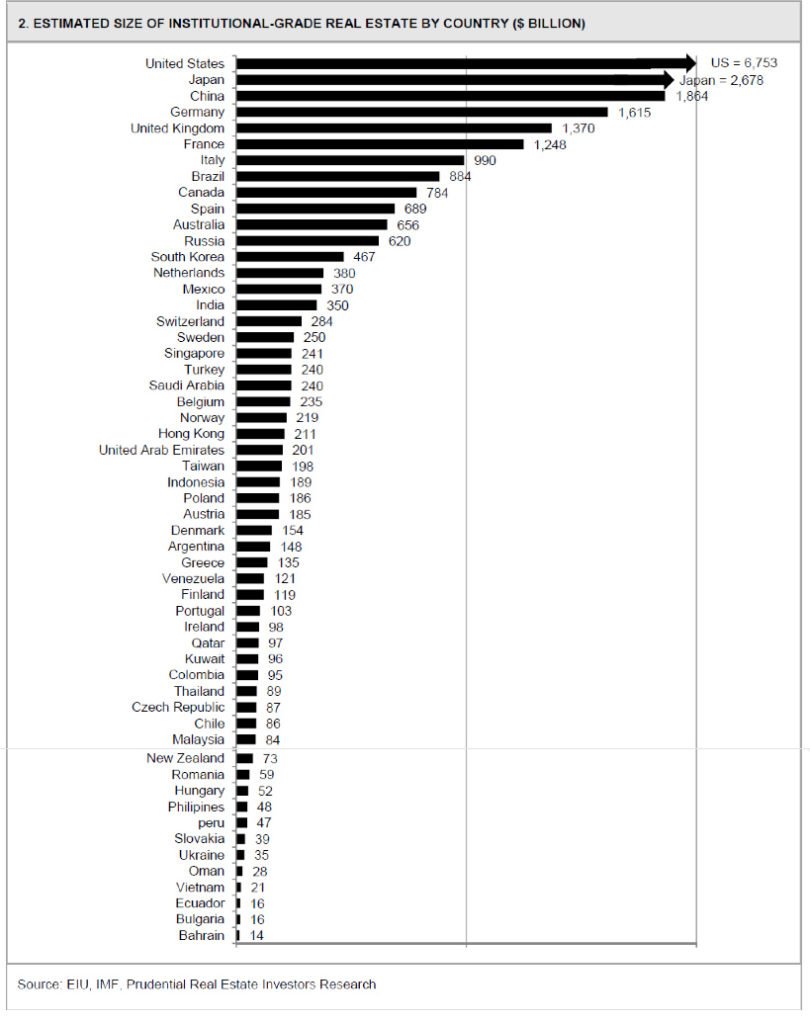
Global Market Concentration
Institutional-grade real estate is heavily concentrated in a small number of countries. The U.S. leads the list with 25.43% of the commercial real estate (CRE) globally, followed by Japan with 10.08%, China with 7.2%, Germany with 6.08%, and the UK with 5.16%. Five of the countries in the top 10 are located in Europe, and the top 10 countries combined encompass a cumulative 71.1% of CRE globally. Furthermore, according to a study by Prudential Real Estate, more than 80% of all commercial real estate is contained within just 15 countries.
Shift Toward the Asia-Pacific Region
This global distribution of CRE is set to change significantly over a 10-year horizon. The Asia-Pacific region is projected to lead the global market, as economic growth in that area will outpace both the U.S. and Europe, ultimately securing the largest share of CRE by 2021. According to the Prudential Real Estate Investors report, the Asia-Pacific region is projected to contain $19.1 trillion of CRE by 2021, representing a massive 166% increase from 2011. This growth will be fueled by an expected economic expansion of over 10% in the region, which will translate into rising wealth and a heightened demand for institutional types of CRE, such as large shopping malls and office buildings. With these shifting dynamics, the Asia-Pacific region will encompass 39.2% of the world’s CRE by 2021.
Growth Profiles in Europe and North America
In comparison, other major regions will experience more moderate structural adjustments. The European region is expected to grow to $13.3 trillion in 2021, marking an increase of 42% from 2011. Despite this volume increase, Europe will see its total share of global CRE drop to 27.4% in 2021, down from 35.4% in 2011. Similarly, the U.S. and Canada market will increase to $11.5 trillion by 2021—a 53% expansion from 2011—but its overall global market share will contract to 23.6%, down from 28.4%.
Meanwhile, Latin America and the Gulf Cooperation Council (GCC) regions are projected to display minimal relative growth.
Economic Drivers of Commercial Real Estate
Growth in a country’s GDP has a direct, measurable impact on the development of its institutional real estate, as expanding economies generate a larger pool of individuals and corporations wealthy enough to utilize institutional-quality properties. A closer look at the world’s top GDP producers provides a strong indicator of where real estate growth will land over the next 15 years. Beyond structural economic expansion, underlying macroeconomic indicators such as the unemployment rate, debt costs, and a central bank’s ability to keep interest rates low are all critical factors that dictate the net growth velocity of CRE globally. At the baseline of this economic mapping, the U.S. tops the world in total GDP at $15 trillion, followed by China at $7 trillion, Germany at $3.6 trillion, and France at $2.8 trillion.

Emerging vs. Developed Market Growth Rates
In conjunction with the pace of GDP growth, the institutional-grade commercial real estate (CRE) market is projected to expand at a significantly faster rate in developing nations compared to mature economies. China tops the list with a projected annual growth rate of 18%, followed closely by India at 16.6%, Russia at 10.6%, Turkey at 9.2%, and Brazil at 8.2%. In contrast, expansion among developed nations remains stable but considerably more modest, with the U.S. growing at an annual rate of 4.3% and the UK at 3.6%.
Leading Global Contributors and the US-China Duopoly
Despite the rapid percentage growth rates seen across various emerging markets, China and the U.S. will lead the list of absolute contributors to the total volume growth of institutional-grade commercial real estate over the next decade. Combined, these two superpowers are projected to produce more than half of the global CRE growth in value by 2021. Notably, the U.S. stands out as the only developed nation among the world’s top five absolute contributors to global growth, which consists of China, the U.S., India, Russia, and Brazil.

Projections for the Next Decade (2011–2021)
Individually, China will lead all global contributors, projected to grow by an absolute $7.9 trillion between 2011 and 2021. This massive expansion represents 35.5% of total global growth and will bring the total value of China’s CRE market up to $9.7 trillion by 2021, fueled by rapid economic growth and an increase in personal wealth.
The U.S. is projected to take second place, expanding by $3.5 trillion, or 16% of the global total. This will bring the total CRE value in the U.S. to $10.3 trillion, marking a 53% increase from its $6.7 trillion baseline in 2011. Overall, global CRE is expected to grow by $22.2 trillion over the decade, with nearly $14.8 trillion—or 67% of this total growth—coming exclusively from the top five nations.
Historical Comparison (2001–2011)
This heavy concentration of growth reflects an intensification of trends observed over the previous decade (2001–2011), during which the U.S. and China also topped the growth charts. Over that prior 10-year period, the global CRE market doubled, expanding by $13.8 trillion to reach a size of $26.6 trillion by 2011. The primary drivers of that historical expansion were the U.S. (adding $2.1 trillion) and China (adding $1.6 trillion), which together accounted for 27.3% of global commercial real estate growth.
The remainder of the historical top five contributors included Japan ($805 billion), Germany ($767 billion), and Brazil ($749 billion). Together, these five nations accounted for a combined total of $6.1 trillion, or 44% of total historical growth—a stark contrast to the 67% concentration of growth projected for the top five nations in the subsequent decade.

Strategic Considerations for Global Real Estate Investment
Looking ahead, the U.S. and China will continue to grow, while the Asia-Pacific region will see steady growth in volume and profits. Europe will continue to expand as well, but not as much as other parts of the world such as Russia and Brazil. Consequently, cross-border investors will need to take into account a host of factors when making a decision on where to move their money. As noted earlier, developed nations will offer a much safer investment environment, but with lower yields, whereas developing markets will provide higher profits but a great deal of risk. This requires investors to decide whether their investment strategies are long-term or short-term, and exactly how big their appetite for risk is.
For example, Sovereign Wealth Funds (SWFs) are government-owned, meaning it can be assumed that their tolerance for risk is very low, making developed nations a more comfortable investment for them. Ultimately, while risk will be higher in some but not all developing nations, and although a nation’s GDP growth remains a good indicator of how well a particular CRE market will do, investors must look beyond growth numbers to take into account other critical factors such as local demand, transparency, liquidity, governance, and—most importantly—political stability and the institutional legal framework.