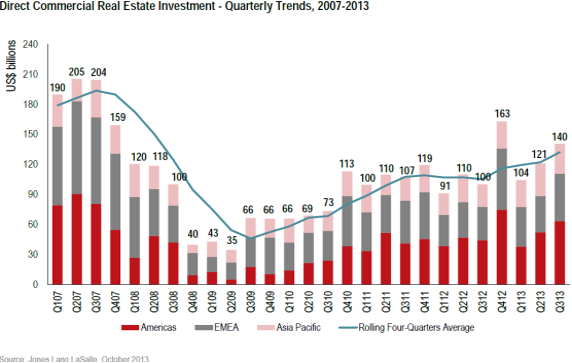
How will the global CRE market be expected to perform in the short term? According to Jones Lang LaSalle, 2014 is set to create new records. The overall investment picture is appealing, with rising investor confidence and increasing competition for core assets in prime locations. This trend is expected to push yields down and drive investor appetite further up the risk curve.
In 2014, investment transactions are estimated to fall within the range of $525–575 billion. The year 2013 was one of impressive growth, surpassing $500 billion in CRE transactions. Corporate balance sheets appeared strong, and stock markets in major financial centers closed the year with significant gains. Meanwhile, Europe seemed to be on track to emerge from its recession, and the Asia-Pacific region continued to maintain steady growth.
Globally, third-quarter 2013 results were 16% higher than those of the second quarter. Compared to 2012, activity through the end of the third quarter increased by 21%, reaching $366 billion versus $301 billion. The report estimates that the U.S. real estate market—the largest in the world—would grow by 10–15% in 2014.
In the U.S., Q3 2013 investment volume reached $55 billion, marking the first time since 2007 that quarterly volume exceeded $50 billion. Investor demand remained strong, particularly in core markets. The office sector led growth, with sales volume increasing by 32% compared to previous years. This growth was largely driven by the availability of capital and low interest rates.
Secondary markets in the U.S., such as Atlanta, also contributed to this expansion, as investors began seeking higher yields outside highly competitive primary markets. The overall data shows a clear upward trend in quarterly activity over the past six years. Despite this progress, 2013 was expected to finish about 33% below the 2007 peak of $758 billion in global transactions. Even so, the global CRE market has been recovering at a strong and steady pace.
Asia-Pacific had a strong 2013, with transactions reaching $120 billion. This growth is expected to continue into 2014, with projections rising to $130 billion. Much of this expansion is driven by key markets such as Japan, Australia, China, and Singapore. In particular, offshore investors are fueling growth in Australia and China. Reports suggest that the Asia-Pacific region could set new records in 2014.
Europe is also expected to grow by 5–10% in 2014, led primarily by United Kingdom, Germany, and France, with additional contributions from Central and Southern Europe. Countries such as Poland, Spain, and Netherlands are expected to experience notable growth and attract increased investor attention. Overall, recent data provides a clear indication of where the market may be heading in the coming years.
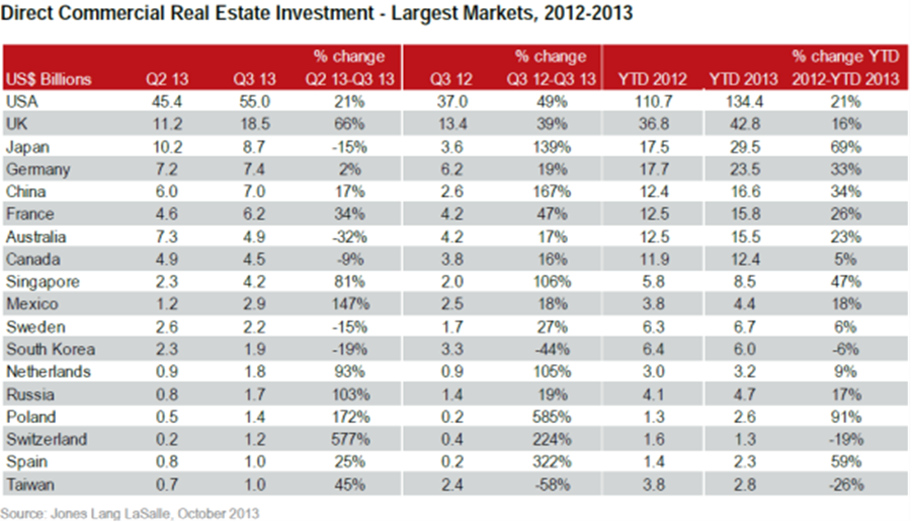
In my view, while 2014 may not match the peak levels of 2007, it is likely to be a very active year globally. The U.S. market will continue to grow, supported by both private and public investors. The office sector is expected to maintain its upward trajectory, while the industrial and logistics sectors will see strong growth, particularly along the East Coast and Gulf Coast. The expansion of the Panama Canal, scheduled for completion between 2015 and 2016, is expected to significantly influence market dynamics. Demand will also be driven by retail and manufacturing sectors.
Cap rates and yields are expected to remain compressed, leading to a shift of capital from primary markets to secondary markets within the U.S. This trend is likely to extend across other developed economies, where strong demand for core-plus assets is reducing availability and pushing investors toward higher-risk opportunities. Capital flows from the MENA region and China into European markets are expected to continue, with London remaining a key safe-haven destination.
Higher yields in 2014 are likely to be found in secondary markets across Asia—such as India, Vietnam, Laos, Malaysia, and Indonesia—and in Latin America, including Brazil, Chile, and Colombia. Notably, Colombia was ranked as the top destination for foreign direct investment in 2014. Africa is also emerging as an attractive market for investors seeking higher returns, with South Africa leading the way, alongside growing opportunities in Ghana, Kenya, Nigeria, Botswana, Uganda, Angola, Namibia, and Mozambique.
For lower-risk investors, Europe will remain a stable option, though yields in primary markets will continue to decline. Core and core-plus assets in major cities such as Frankfurt, Berlin, and Paris will be increasingly difficult to acquire. However, secondary markets like Manchester and Birmingham, along with Eastern and Southern Europe, will offer more opportunities.
Can the Libyan Investment Authority (LIA) play a significant role in this $500 billion annual market? The answer is yes. However, while the LIA Real Estate & Hotel Fund has been established, it currently suffers from limited accessibility and fragmented assets. The Real Estate Department should take full responsibility for reviewing, executing, and managing investments—something that is not yet effectively implemented.
Geographically, LIA should prioritize investments in (1) Libya, (2) Europe, and (3) the U.S., while continuing to address its existing African assets. During economic slowdowns, sovereign wealth funds often refocus domestically to stabilize their economies. Libya, currently in need of rebuilding, presents a major opportunity for LIA to invest directly or through joint ventures with international partners.
Africa remains a compelling long-term investment destination due to its rapid economic growth, improving political stability, and expanding population. With a combined GDP of approximately $2 trillion and a population of around 1 billion, the continent is expected to surpass China in workforce size by 2035. Investment opportunities span infrastructure, education, healthcare, retail, and agriculture.
For capital allocation over the next three years, a suggested distribution would be 50% in Libya, 25% in Europe, and 25% in the U.S., while maintaining and better managing existing African assets. Establishing a U.S. office is essential for entering the world’s largest real estate market, valued at approximately $6 trillion. In Europe, LIA’s London office can serve as a strategic hub for global operations.
In terms of property types, LIA should diversify across sectors. In Libya, focus should be on mixed-use developments, retail, logistics, affordable housing, and entertainment infrastructure. In Europe, short-term investments should target office and retail sectors, with long-term plans for hotels. In the U.S., industrial, office, and logistics sectors should be prioritized, again with long-term interest in hospitality. In Africa, emphasis should be placed on restructuring hotel assets and investing in agricultural land.
Regarding risk classification, LIA should adopt a balanced strategy. In Europe, an allocation of 80% core-plus and 20% value-added is recommended. In the U.S., 70% core-plus, 20% value-added, and 10% opportunistic investments would provide diversification. In Africa, the immediate priority should be improving management of existing assets. Expected returns vary by category, ranging from 7–10% for core investments to 18%+ for opportunistic strategies.
A major challenge for LIA is human capital. The organization must invest in training and education to develop a new generation of Libyan investment professionals. This includes sending top graduates to universities in the U.S. and U.K. for advanced studies in finance, economics, and real estate, with guaranteed employment upon completion. Strengthening internal expertise is critical for long-term success.
Investment structures must also be carefully designed to limit liability and protect national assets. Jurisdictions such as Luxembourg can provide efficient structures for European investments. Emphasis should be placed on tax efficiency, legal protection, and appropriate corporate structuring.
In summary, LIA should focus on key operational priorities, including environmental considerations, governance, risk management, cost control, tax optimization, and strategic partnerships. Real estate remains a dynamic and evolving sector, requiring continuous monitoring of economic conditions. Ultimately, investor success will depend on the ability to adapt to changes at local, regional, and global levels.